
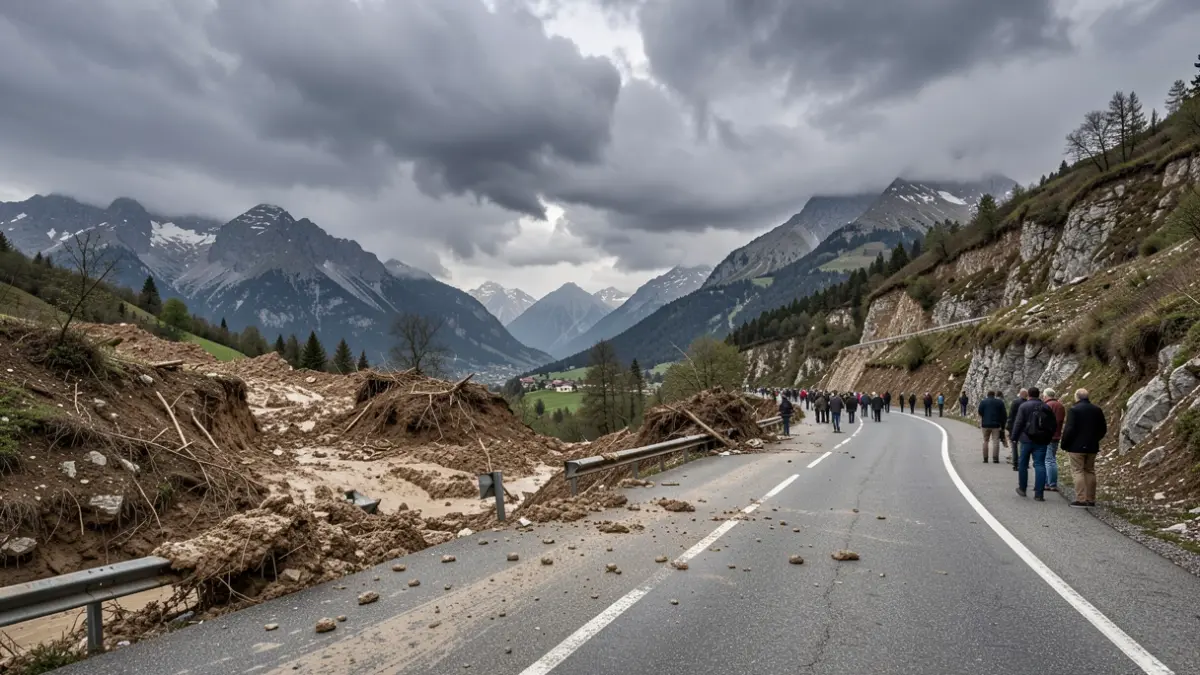
The road leading to Pré de Madame Carle was destroyed following an exceptionally violent storm on August 28th, an unprecedented event for the departmental road network. This observation, shared by officials from the Roads, Road Infrastructure, and Aeronautics Directorate, highlights the growing impact of climate change on infrastructure.
Meteorological phenomena are now "increasingly random, intense, and frequent," directly affecting road management. While the current organization "holds firm," financial impacts are already significant, with emergency works funding nearing €600,000 by June 2026, a sum typically covering a full year. This situation necessitates proactive and rigorous financial management.
The unpredictability of torrential mudflows severely strains weather forecasting tools. Mathematical models struggle to keep pace with changes, making it difficult to determine rain-snow limits and anticipate sudden events like the one at Pré de Madame Carle. Direct contact with Météo France in Aix-en-Provence is being considered for improved responsiveness.
The shift towards more probabilistic forecasting systems, such as "X% chance of snow," could facilitate intervention planning, particularly for ice and snow. The winter "temperature yo-yo" demands constant vigilance, eliminating the usual respite periods after winter road maintenance.
In response to these challenges, the Department is compelled to adopt "more agility, speed, and flexibility." Rising temperatures cause simultaneous grass growth across the territory, complicating mowing. New legal requirements, such as widening the roadside clearing zone, add to the complexity.
New public procurement procedures are being studied, while technical departments aim to maximize in-house work. A recent example is a mudflow in the Queyras in late September, quickly managed thanks to nearby departmental equipment, although final clearing required an external company. These events, once rare, have become "systematic."
Natural risks are now a priority in the Department's projects. Forecasts indicate a decrease in frost days and a rise in temperatures by 2050, accompanied by an increase in intense rainfall and fire risk, particularly in Gap.
A timeline of recent events illustrates these disruptions: on June 25th, 150 meters of the RD 1091 near Grand Clôt were swept away by a mudflow, costing the Department €450,000. On July 11th, access to Ceillac and Château-Queyras was cut off by mudflows (cost: €310,000). On August 21st, a rockfall on the RD 902 caused a serious accident, leading to geotechnical studies (cost: €6,000).