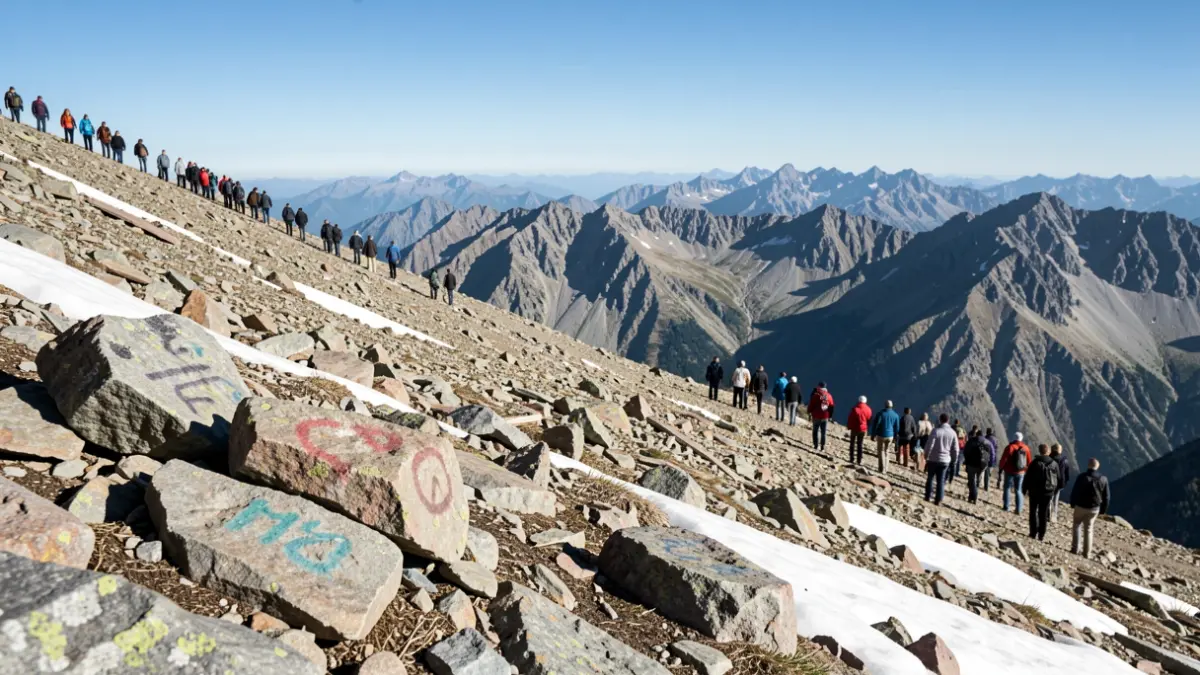
On Tuesday, September 22, 2026, a team of researchers, including Xavier BODIN and Josué BOCK from the EDYTEM laboratory (Environments, Dynamics and Mountain Territories), a joint research unit of the CNRS and the Université Savoie Mont Blanc, resumed monitoring rock glaciers in the valley overlooked by the Farnéréita peak and the Crête de Coq, near the Clausis chapel in Saint-Véran.
This monitoring, initiated in 2019 as part of the PermaFRANCE observatory, aims to track the evolution of permafrost in the French Alps. Anne GOUSSOT, biodiversity officer at the Parc du Queyras, explains that the work focuses on two rock glaciers in this valley.
Permafrost, also known as frozen ground, is permanently frozen soil, found above 2500 m altitude in the Alps. A rock glacier is a mixture of rock debris and ice moving at very low speeds (a few centimeters to a few meters per year) down a slope, indicating the presence of permafrost. It should not be confused with black glaciers, which are white glaciers covered with debris.
The Parc du Queyras, covering 618 km², counts 59 rock glaciers with a total surface area of 12 km². Some, like those of Farnéiréta, are active and move, while others are considered "fossilized".
The activity of these rock glaciers, which result from periglacial processes, depends on current and future climatic conditions. Climate change can alter their thermal state, potentially affecting water resources or slope stability.
Annual measurement campaigns, conducted by the EDYTEM laboratory and the PNR du Queyras, analyze the displacement speed of these rock glaciers. Researchers take GPS readings on about twenty blocks, measuring their exact position with centimeter precision using a differential GPS. Reference points outside the glaciers are also used to validate the data collection.
Concurrently, temperature data is collected from the surface of the rock glaciers and from a "control" sensor in a non-permafrost context.
Field observations suggest increased activity in certain areas, but definitive conclusions will depend on comparing data from 2025 and 2026. Previous measurements indicate displacement speeds of a few meters per year.
These rock glaciers were chosen for their significant movement and accessibility. Factors such as snow cover, rising temperatures, summer heatwaves, and violent localized storms can influence their movement.
The melting of these rock glaciers raises questions about their role in local hydrological cycles, particularly during low-flow periods. Marc FIQUET, hydrogeologist and director of the Parc du Queyras, emphasizes that these potential "hydrogeological reservoirs" are still poorly understood.
The Park has initiated actions to better understand these formations. A Master 2 intern from the Université de Savoie Mont-Blanc, Loïc BLANC, collected and analyzed data, conducting initial field investigations.
Very low temperatures, reaching 1.6°C, were recorded in water flows at the front of some rock glaciers, such as the one near the Col la Noire, significantly colder than surrounding springs and streams.
The fate of the water and snow that feed these rock masses remains an open question, requiring further research to understand these invisible processes.