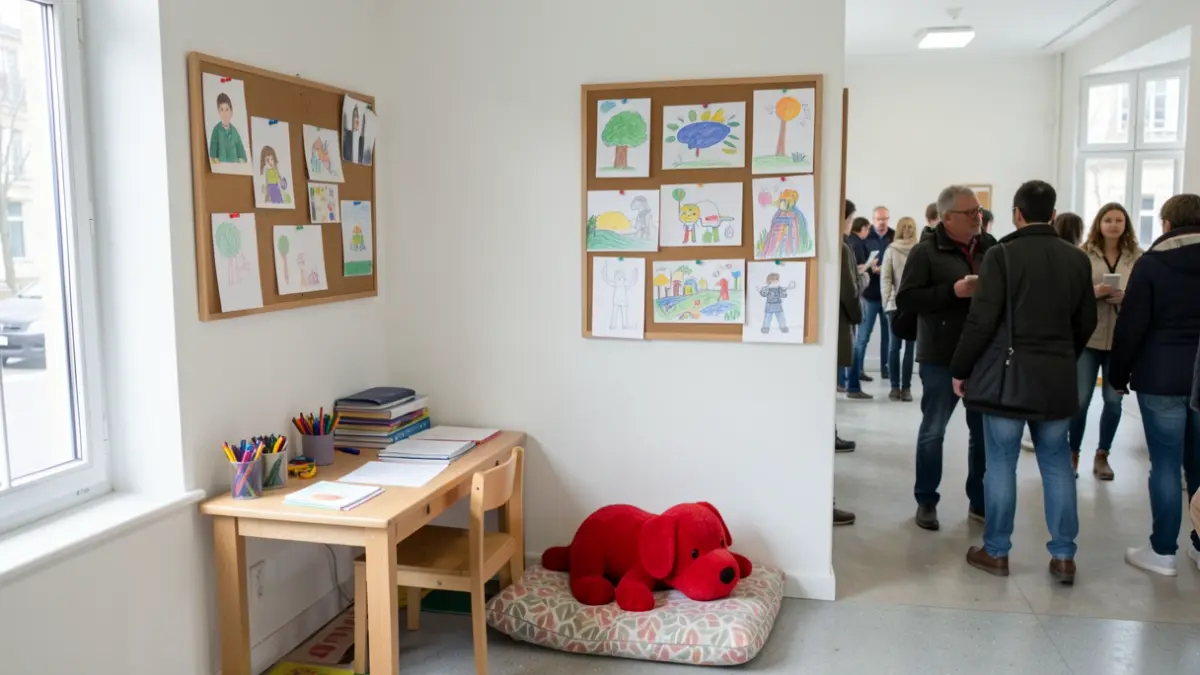
For several weeks, Room 222, located on the second floor of the Departmental Hotel, has become a central hub for young people and adults involved in the adoption process or becoming foster parents. This space, still under development, is designed as an essential work tool for the Adoption Unit.
The room's white walls are adorned with children's drawings, markers, colored pencils, and toys, including a large red plush dog. These elements aim to create a safe and welcoming environment for the youngest. As psychologist Sophie Dol explains, 'We do not receive a child's words in the same way as an adult's. Younger children need to express themselves through various mediums: drawing, body language... This requires specific conditions. They also have a strong need for reference points. Having a dedicated, secure space allows them to identify its function: here we talk about their life project.'
“"We do not receive a child's words in the same way as an adult's. If verbal exchange is normally easy for the latter. Younger children need to express themselves through various mediums: drawing, body language..."
In situations where parents can no longer care for their child, the Department intervenes within the framework of Child Social Welfare. Following an administrative and judicial process, the Commission for Examining the Situation of Entrusted Children may decide that these children become wards of the State. If the path to adoption opens up for them, Room 222 then becomes a key place in their journey.
In Room 222, children will meet Sophie for the psychological aspect and Virginie Franzese-Lauthier for the socio-educational aspect. Regular interviews, lasting up to six months, will help them explore their history, grieve the loss of their biological parents, and consider a new life with new parents. This space also allows prospective adoptive parents, who undergo a demanding process to obtain approval, to discuss the challenges of adoption with Sophie and Virginie, particularly regarding the violence and trauma children may have experienced.
Young people under Child Social Welfare can also consult their files in Room 222, a space designed to understand the past and build the future.