For the sustainable development of offshore wind turbines, industry professionals lacked field data, particularly from the Mediterranean. The BIODHYL project, managed by France Énergies Marines, addresses this gap. Jean-François Briand, a researcher at the MAPIEM laboratory of the University of Toulon, has developed a novel protocol for monitoring biofouling.
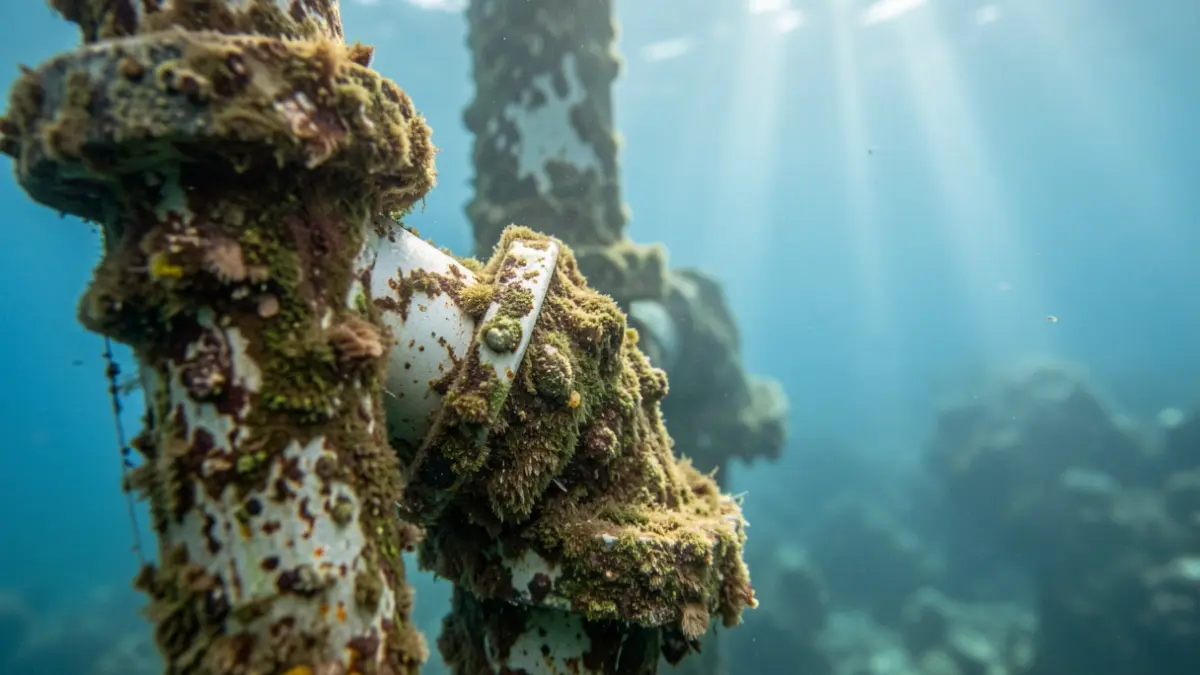
Floating offshore wind energy requires the large-scale deployment of artificial structures at sea. Once submerged, these are rapidly inhabited by marine life. This phenomenon of biofouling (or biocolonization) increases material fatigue, accelerates degradation, raises maintenance costs, and poses long-term ecological questions that are still poorly documented.
The lack of long-term offshore data remains a major obstacle for the development of marine renewable energies (MRE). "The data that industrial players had until now came from experience in the North Sea. However, colonization differs significantly from one sea to another, impacting the design of mooring lines and dynamic cables," explains Jean-François Briand, a lecturer at the IUT of Toulon and a researcher in microbial ecology at MAPIEM, specializing in marine biofilms.
The R&D project BIODHYL, conducted from 2022 to 2026, aimed to overcome this challenge. "This is the third project led by France énergies marines that we have participated in over the past eight years," notes the researcher. This trust from the national institute allowed his team to conduct multi-year monitoring at four sites, in the Atlantic and the Mediterranean, resulting in the collection of unprecedented data.
Within this project, Jean-François Briand and his post-doctoral researcher, Aurélie Portase, developed an innovative protocol for identifying the biodiversity colonizing submerged structures using DNA sequencing. This method offers a welcome change from traditional morpho-taxonomic approaches, which rely on visual identification, abundance, biomass, and size measurements. While precise, these methods are time-consuming, require specialized taxonomic expertise, and often underestimate discreet, cryptic, or small species.
"The BIODHYL project has notably demonstrated the complementarity of molecular and morphological approaches to improve the understanding of biocolonization diversity and function," he assures.
In the Mediterranean, the team monitored the colonization of buoys in Leucate and Cap Couronne for two years, as well as near the site selected for an offshore wind farm in the Gulf of Fos. Samples taken at 2, 20, and 40 meters depth revealed its influence on community composition. While morpho-taxonomy showed only low richness dominated by three invertebrate genera (Jassa, Caprella, Mytilus), environmental DNA (eDNA) sequencing uncovered a majority of micro-eukaryotes (56% of detected taxa) previously invisible to researchers. The combination of methods confirmed differences between sites and refined the monitoring of community evolution over time.
More broadly, factors shaping biofouling (depth, temperature, nutrients, current speed) were identified through the complementary study of two sites on the Atlantic coast, cross-referencing in-situ measured parameters with data from numerical models. A methodology was developed to measure their influence on biocolonization dynamics.