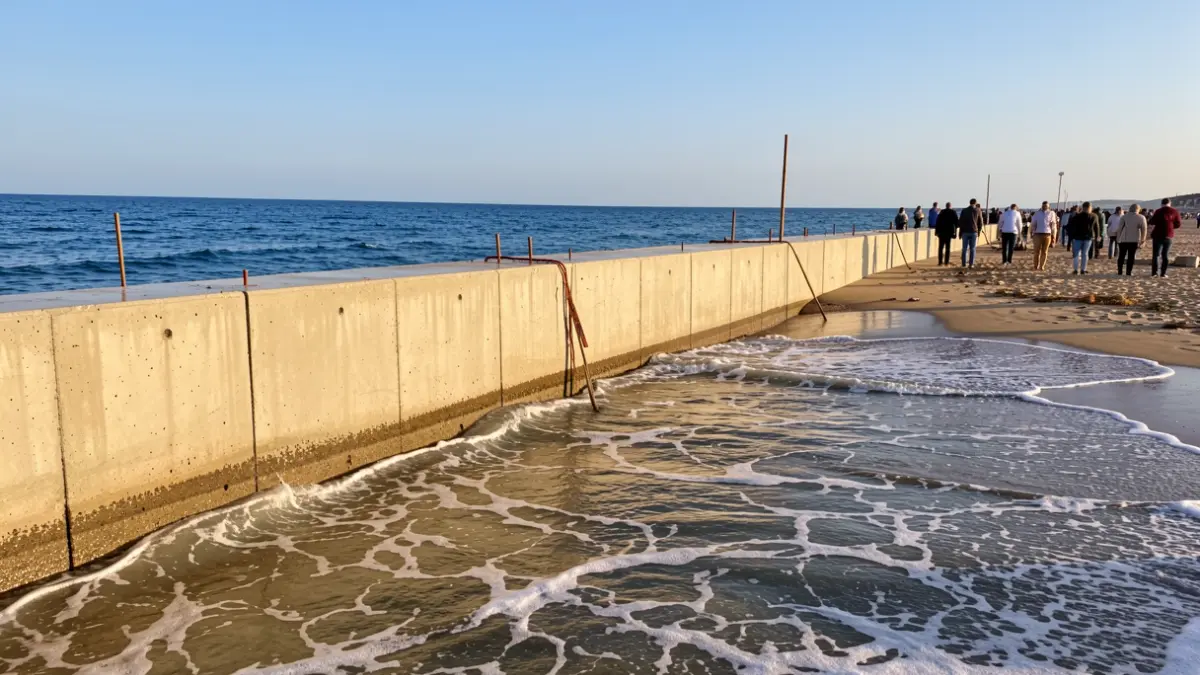
The current retaining wall, built in 1977 and subsequently repaired, shows significant degradation. It is affected by wave action, progressive shoreline retreat, and material erosion at its base, causing undercutting and multiple cracks in its footing.
The project involves resizing and reinforcing the wall to ensure the long-term stability of the boulevard, protect the road, and restore beach continuity by removing rock armor. These works aim to strengthen the wall weakened by erosion, support the reconstitution of Gigaro beach, and re-establish its East-West continuity, currently interrupted by the loss of part of the sandy spit.
The objective is also to reduce wave overtopping to limit submersion risks and maintain access to the area during heavy swell episodes. Particular attention is paid to the environmental and landscape challenges, with adapted architectural integration and minimal occupation of the maritime public domain.
The new wall, built against the existing one, will feature a cap designed to deflect the upper part of waves, limiting water ingress onto the boulevard during storms. The current rock armor at the wall's base will be removed, with some material potentially reused for the new structure's foundation. The project's design also incorporates projections for sea-level rise due to climate change.
The Gigaro sector presents specific environmental and heritage challenges, being located within a site registered as a "Bâtiments de France" area and part of the Natura 2000 zone "Corniche Varoise". The apparent texture of the wall has been approved by the urban planning department of the municipality of La Croix Valmer and the architect of the buildings of France.
These works are carried out under the responsibilities of the Golfe de Saint-Tropez Community of Communes concerning aquatic environment management and flood prevention (maritime GEMAPI).