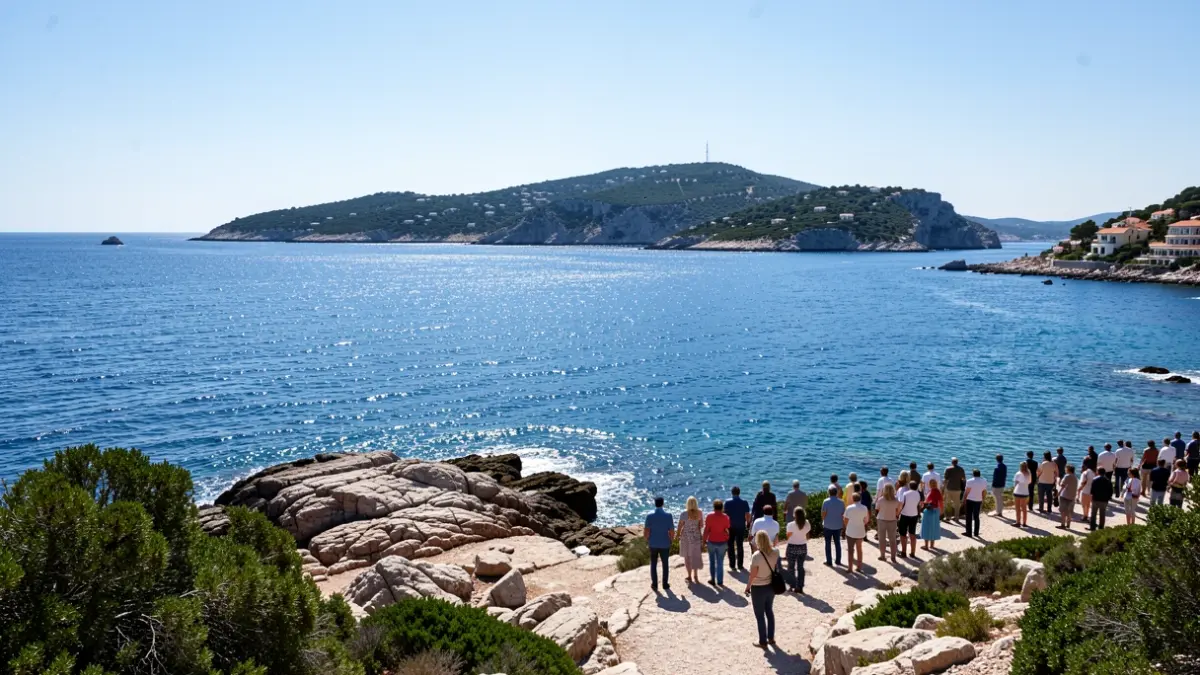
On Thursday, September 17th, students from programs related to the Port-Cros National Park presented their projects developed within the framework of Situations d’Apprentissage et d’Évaluation (SAE). The event, titled "Focus on Port-Cros National Park: Crossed Perspectives," took place before an audience of peers, research professors, and park representatives.
Students from Biological Engineering (2nd and 3rd year, SEE track) worked on establishing scientific monitoring for two underwater trails, one in a highly protected zone and another less so. They had 40 minutes to convince the audience of the relevance of their approach. Students from the Life Sciences Bachelor's degree (2nd and 3rd year, SEGE track) took on the "project in 180 seconds" challenge, a short and impactful format to summarize their research. Finally, students in the Master's in Marine Sciences presented a multidisciplinary workshop reflecting the diversity of field challenges.
These presentations were followed by an informal exchange, allowing working group members to share their field experiences, receive advice from professors, and from Franck Alary, the environmental education representative for the National Park. This day underscores the commitment of the University of Toulon (UTLN) to grounding its programs in the region's reality.
Since 2019, the Life Sciences Bachelor's program has offered an "eco-guide" option in partnership with the Port-Cros Park, training students in scientific mediation and guiding public groups in natural environments. Former students, such as Marc and Célestine, joined the Collective for Environmental Initiatives between Land and Sea (CIETM) during the summer, where they led public awareness activities.
The Biological Engineering department at the IUT also formalized an agreement in 2023 with the PNPC, enabling students to practice terrestrial plant and fish inventories under the supervision of domain professionals. This initiative has since expanded to the Park's membership area to compare zones with different levels of human pressure.
An agreement signed in 2025 between the University and the Port-Cros National Park has strengthened this bond, providing for joint scientific projects, staff exchanges, and dissemination of results, making the PNPC an open-air laboratory for researchers and students.
These collaborations offer students the opportunity to work on real-world issues, develop sought-after skills in the job market, and place themselves in professional situations. The Park, in turn, benefits from the academic expertise and energy of the students, while the University provides an exceptional setting for training and innovation.