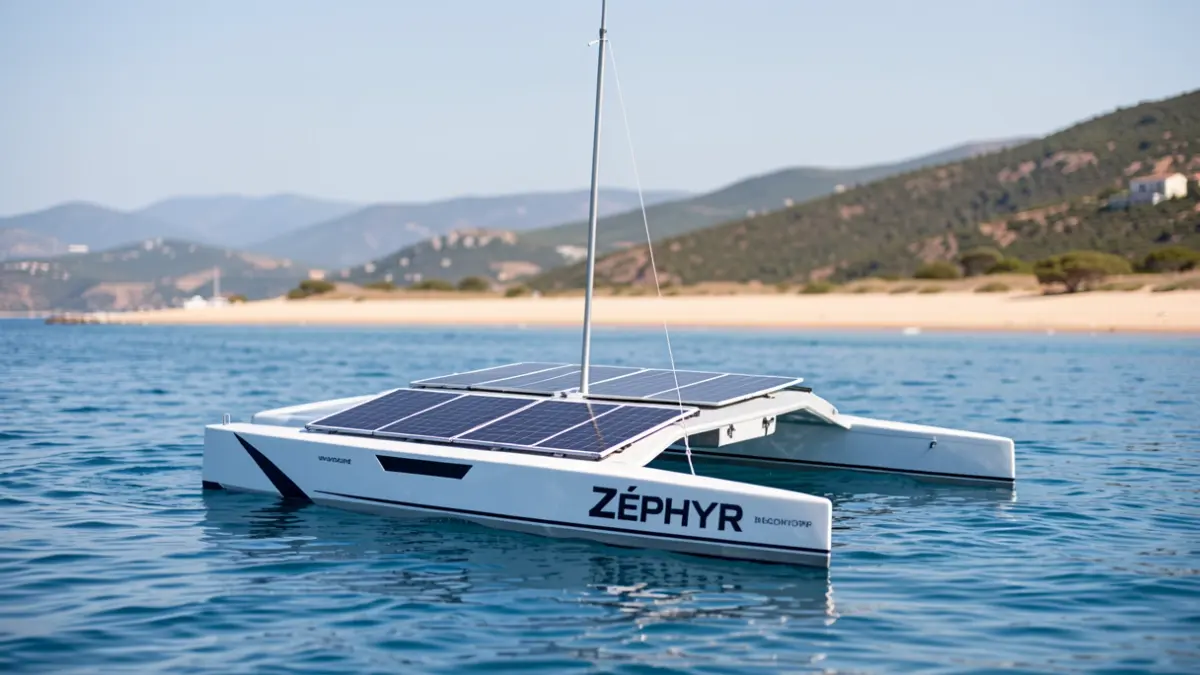
After years of design, construction, and learning, the autonomous trimaran Zéphyr, conceived by the engineering students of SeaTech – Engineering School of the University of Toulon, has officially joined its natural element. This first launch, which took place on Peno beach in Carqueiranne, marks a crucial milestone for the project led by the student association HydroSharks. It concludes an intensive construction phase and paves the way for sea trials, system development, and future autonomous missions.
This symbolic event brought together the active members of HydroSharks and key contributors to the project. Among them, three former students from the 2023 cohort, Thibault Le Bihan (2023 president, engineer at Thales), Maxime Vandevoorde (2023 treasurer, at the CNRS), and Gwendal L’Arvor (2023 secretary, at Naval Group), traveled to attend. The project also received support from the University of Toulon, the Métropole Toulon Provence Méditerranée, and the Chamber of Trades and Crafts of the Provence-Alpes-Côte d’Azur Region. Representatives from these institutions, including Jérôme Begnis (CMAR PACA), Jean-François Chailan (former SeaTech director), Ms. Charlène Czaja (Métropole TPM), and Mr. Éric Joffre (University of Toulon), were present, highlighting the collective nature of the project.
The Zéphyr, measuring 4.7 meters long and 3.3 meters wide, is designed as an autonomous scientific platform. It is intended to carry various instruments and sensors for sea measurement campaigns. Its architecture will integrate autonomous navigation systems (GPS, inertial unit), a weather station, cameras, a sonar, and a lidar. Its energy system, based on two solar panels and four batteries, aims for several days of autonomy, maximizing solar energy use. This platform offers a solution for conducting oceanographic measurements over extended periods, potentially at lower costs and with a reduced environmental footprint, without requiring a manned vessel.
This multidisciplinary project mobilizes diverse skills: mechanical and composite design, naval architecture, electronics, energy, IT, automation, robotics, and autonomous navigation. Students benefit from the school's support and the guidance of research professors from the IMATH and MAPIEM laboratories, such as Mr. Mehmet Ersoy, Ms. Lyudmyla Yushchenko, Ms. Sophie Berlioz, and Mr. Fabien Mathé (PhD student at the COSMER laboratory). The continuity between cohorts and the link with teachers are key strengths of the project.
A significant collaboration with the CFA of CMAR PACA in La Seyne-sur-Mer marked the year 2026. Apprentices in composite CAP and automotive painting programs worked alongside engineering students on the hull lamination. This cooperation, supervised by Noël Saunier from NS Composite, enabled a key construction step and exemplifies HydroSharks' objective: learning by doing and transferring skills.
The environmental dimension was integrated from the design phase. The hull uses a bio-sourced epoxy resin combined with fiberglass and flax fiber to minimize the ecological footprint. The energy architecture, with solar panels and batteries, reinforces this sustainable approach. The Zéphyr thus serves as an experimental ground for considering the performance, design, and sustainable operation of autonomous systems.
After years of development, the Zéphyr touched the water for the first time on Carqueiranne beach. This launch initiates a new phase of sea trials, validation, and improvement of the onboard systems. Upcoming steps will allow students to test design choices against real navigation conditions and further refine the trimaran in real-world scenarios. The HydroSharks association warmly thanks its partners: Alseamar, CFA La Seyne-sur-Mer, IxBlue (Exail), Métropole TPM, VN Composite, and the Town Hall of Carqueiranne.