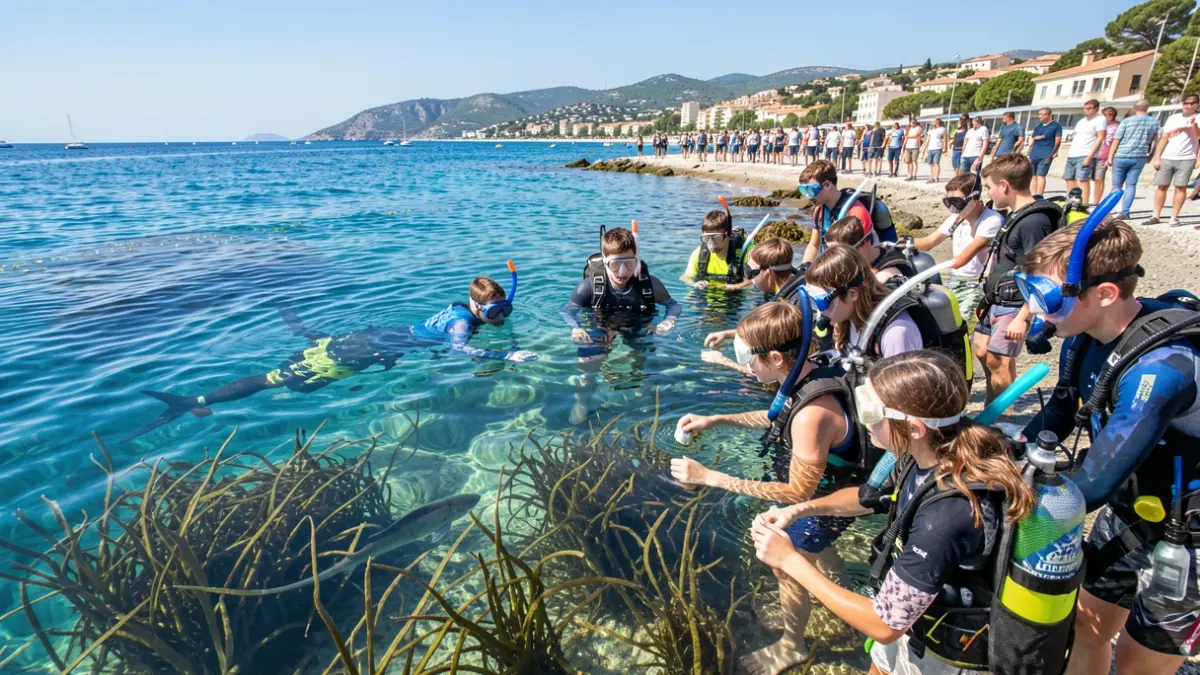
At Lycée Beaussier, a class began their learning directly in the field. Accompanied by Céline Jacot, the referent teacher for the Cordée H2Orizon program, students equipped for snorkeling and guided by a marine biologist, observed marine life in its natural habitat. This sensory experience aimed to spark curiosity and a desire to protect this environment.
A meeting with Dominique Calmet, an oceanographer, then allowed students to better understand the essential role of Posidonia seagrass in the Mediterranean ecosystem. Through studying the seagrass meadows, they explored key concepts such as biodiversity, habitat, ecological balance, and human pressures, making abstract scientific notions tangible.
With the scientific mediator from the association Chercheurs en herbe, the students broadened their perspective. They understood that the Marine Educational Area is not an isolated space but is connected to the land through watersheds and rivers. The presence of the Oïde facilitated understanding the interactions between the watershed, the coast, and the marine environment, highlighting the complexity of this ecosystem subject to multiple influences.
The morning continued with Marion Clément, head of biodiversity and water quality for the TPM metropolis. Students learned about the tools and actors involved in preserving this local biodiversity hotspot, such as the Bay Contract and Natura 2000, realizing that environmental protection relies on scientific observation, territorial knowledge, and collective action.
The day concluded with a meeting with fishermen from the association Les Pointus. Beyond biodiversity, students discovered another valuable heritage: that of the men and women who built their history around the sea. The fishermen's testimonies shared practices, know-how, and a maritime memory integral to the territory's identity.
This day marks the launch of an annual project where students will observe, measure, and document their Marine Educational Area. The goal is to move from discovery to action, by imagining concrete initiatives for their coastal and marine space. The young people thus become observers and ambassadors of their territory, embarking on a scientific, civic, and human adventure that has just begun in La Verne.